 Trusted industrial bearing supplier delivering durable and high-performance solutions across
industries.
Trusted industrial bearing supplier delivering durable and high-performance solutions across
industries.


What Are Thrust Ball Bearings? Types, Working, and Industrial Applications
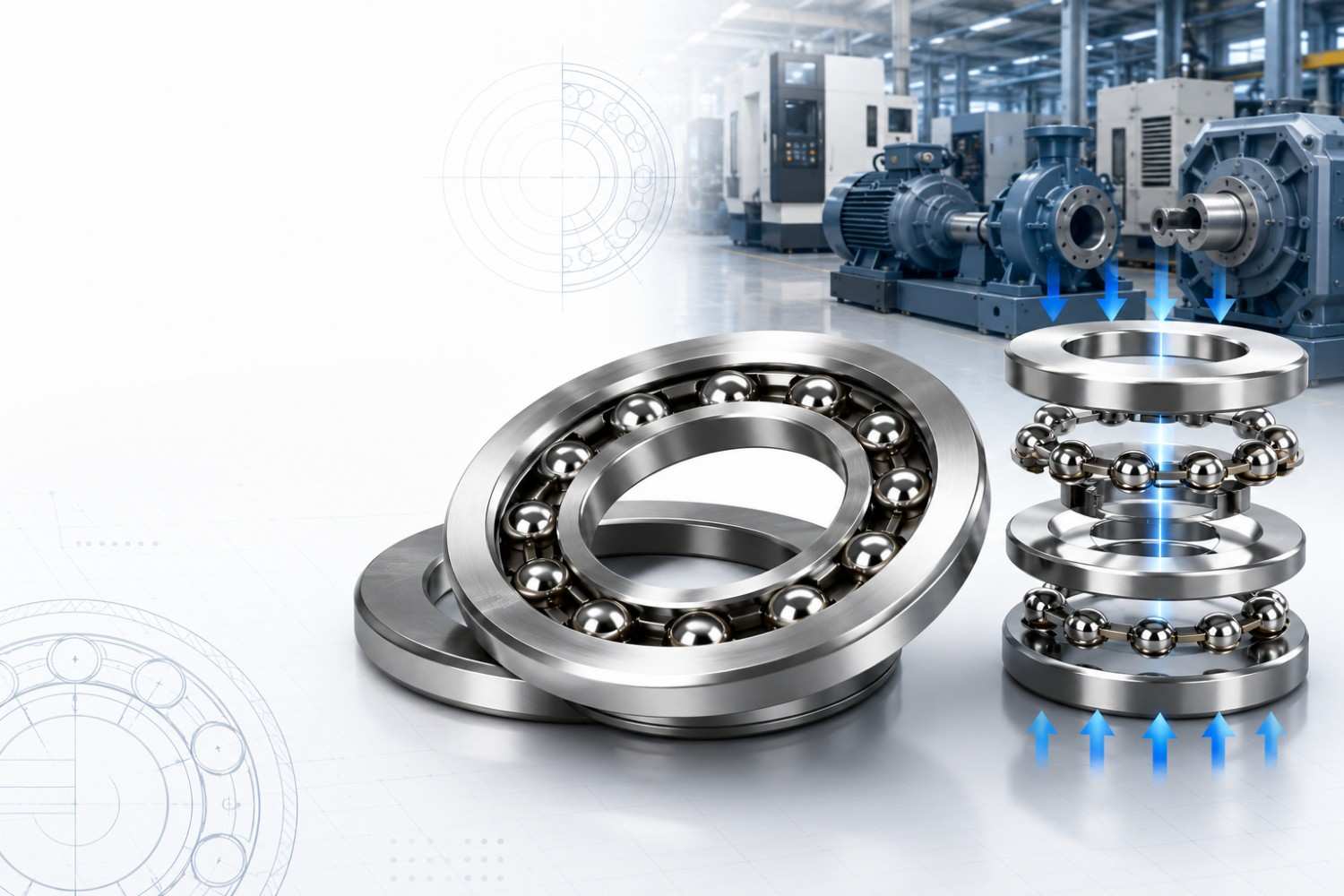
A practical guide to axial-load components, how they function, and where they belong in modern machinery.
Machines deal with two kinds of load. Radial force pushes sideways against a shaft. Axial force pushes along it. Most bearings are built for the first kind — Thrust Ball Bearings exist for the second. They sit between two grooved washers (called races) and let a shaft keep turning while carrying pressure straight down its own length. Wherever a machine can't afford to let axial force shove a shaft out of alignment, you'll find one of these tucked in somewhere: pumps, gearboxes, even the motor in a kitchen appliance.
Here's what these bearings actually do, which variants are worth knowing, and where they turn up across Indian industry.
What Is a Thrust Ball Bearing?
Strip it down and it's just two washers with a ring of balls trapped between them. That's really it. But this simple arrangement does something a standard bearing can't manage on its own: absorb force running along the shaft's axis instead of across it. As the shaft spins, those balls roll through their grooves, cutting friction so the machine isn't grinding itself apart under constant pressure.
DID YOU KNOW? Early water pumps used thrust-style bearing arrangements long before the design was ever formalized for modern industrial machinery.
Some designs only take pressure from one side. Others take it from both — useful when the load on a shaft flips direction mid-operation, which happens more often than people expect.
Why Is It Important?
Skip the dedicated thrust bearing, and a shaft under axial load wears unevenly. It vibrates. Eventually it gives out, often sooner than anyone planned for. And that failure rarely stays contained — whatever the shaft connects to takes the hit too. Knowing your Thrust Ball Bearing Uses before you buy saves that headache down the line. Forcing a radial bearing into an axial role is a mismatch, plain and simple, and mismatches turn into downtime nobody budgeted for.
Types of Thrust Ball Bearings
No single type covers every job — Nachi, along with other manufacturers, makes several configurations, and the right one depends on load direction, speed, and how tight the tolerances need to be.
- Single-direction thrust bearings handle load from one side. Common in vertical shaft setups.
- Double-direction thrust bearings are built for shafts where the load pushes both ways.
- High-precision thrust bearings go into spindles and machine tools that can't tolerate much vibration.
- Custom-specified thrust bearings get built around a load, speed, or housing spec that standard sizes don't cover.
- Stainless Steel Thrust Ball Bearings step in when moisture, washdown cycles, or corrosive exposure are part of the daily routine.
Features to Look For
Size won't tell you whether a bearing actually fits the job. A proper Thrust Ball Bearing Specification looks at more than one number.
- Load capacity — the axial force the shaft will actually see, not a rough estimate.
- Cage construction, which keeps the balls evenly spaced so load doesn't bunch up in one spot.
- Material. Chrome steel handles most general use; Stainless Steel Thrust Ball Bearings take over where corrosion is a genuine risk.
- Speed rating. Push past it and the races heat up fast — faster than most people expect.
- Dimensional accuracy, which is often the real difference between a smooth-running machine and one that hums louder every week.
TRIVIA: Bearing races are sometimes finished to tolerances measured in microns — tighter than most people would guess.
Product Overview: Nachi Thrust Ball Bearings
Nachi has earned a solid name across Indian industry. Nachi Thrust Ball Bearings are a big part of that reputation, honestly. Built to Japanese engineering standards, they hold up under thermal stress and run with noticeably less friction than a lot of what's out there. That's why procurement teams go looking for Nachi Thrust Ball Bearings Authorized Distributors in India before they place an order. Genuine stock matters. A mismatched part can shut a whole line down.
Buying through established Nachi Thrust Ball Bearings Suppliers in India gets you something harder to put a number on too: someone who knows which bearing suits which machine, not a guess made off bore size alone. For teams that need supply without chasing every order themselves, working with recognized Nachi Thrust Ball Bearings Dealers in India means stock's there when it's needed — already checked, already verified.
Benefits
Here are the benefits of thrust ball bearings:
- Long service life, courtesy of fatigue-resistant steel.
- Quieter running. Less vibration tends to mean less noise.
- Handles loads that swing rather than sit constant.
- Covers a wide range of load demands instead of one narrow use case.
- Performs the same whether the setting is light-duty or genuinely heavy industrial work.
FACT: Premature shaft wear often traces back to axial load that was never properly absorbed to begin with.
Applications and Use Cases
Thrust Ball Bearing Uses stretch further than most people assume, honestly — the list below only covers the common ones.
- Automotive clutch assemblies, gearboxes, torque systems.
- CNC machines and precision spindle arrangements.
- Pumps, blowers, compressors — anywhere fluid has to move under pressure.
- Generators, motors, heavy machinery shafts.
- Agricultural and construction equipment running vertical load shafts.
Thrust Ball Bearing Types at a Glance
Here is the table of Thrust Ball Bearing Types.
| Bearing Type | Load Direction | Best Suited For | Material |
|---|---|---|---|
| Single-direction | One side only | Vertical shaft setups, general pumps | Chrome steel |
| Double-direction | Both directions | Shafts with reversing loads | Chrome steel |
| High-precision | One or both | Spindles, CNC and machine tools | Chrome steel |
| Custom-specified | As per housing spec | Non-standard load or speed needs | Chrome steel |
| Stainless steel variant | One or both | Moisture, washdown, corrosive settings | Stainless Steel Thrust Ball Bearings |
Expert Tips and Buying Guide
Don't just match a bearing to shaft diameter and move on — that's not enough, not really. Check the Thrust Ball Bearing Specification against the equipment manual: bore size, load rating, speed limit, the whole list. Moisture or chemical exposure somewhere in the setup? Lean toward Stainless Steel Thrust Ball Bearings instead of standard chrome steel. Paying a bit more upfront usually beats swapping out a corroded bearing twice a year. And for anything bought in volume, go through recognized Nachi Thrust Ball Bearings Authorized Distributors in India. It cuts the risk of counterfeit parts ending up in a supply chain, and it gives you one place to go if the order isn't right.
ABOUT IBH
IBH, your reliable Nachi Bearing Distributor, Dealer & Supplier in India. IBH is associated with Nachi, a renowned Japanese brand, established its presence in the country almost 8 decades before. IBH established in 1973 the company has more than 80 years experience to ease the sourcing and bearing needs. With the availability of Nachi Technology India Pvt. Ltd. (NTID), who manufactures bearing solutions from their technologically sound plant in Neemrana, Rajasthan IBH is a dependable solution provider that deals with all Nachi pillow blocks, thrust ball bearings, cylindrical roller bearings, etc., equipped with a complete catalogue and all the technical backup available in the industry.
FAQs
1. What is a thrust ball bearing actually used for?
Ans: It's there to handle axial load — force pushing along a shaft instead of across it. Pumps, gearboxes, spindles, even small motors use them to keep a shaft turning smoothly under constant pressure. Without one, that pressure wears the shaft unevenly and things fail faster than they should.
2. How is a thrust ball bearing different from a regular ball bearing?
Ans: A regular ball bearing manages radial load, force pushing sideways against a shaft. A thrust ball bearing does the opposite job entirely. It's built to absorb force running along the shaft's own length, which is exactly why swapping one for the other usually ends badly, and quickly.
3. Are Nachi thrust ball bearings actually worth the price?
Ans: Generally, yes. They're built to Japanese engineering standards, run with less friction, and hold up well under thermal stress. For machines that can't afford downtime, paying a bit more upfront for genuine Nachi stock usually costs less than replacing a cheaper bearing twice a year.
4. When should I go with stainless steel thrust ball bearings instead of standard ones?
Ans: Whenever moisture, washdown cycles, or chemical exposure are part of daily operation. Standard chrome steel corrodes in those conditions over time. Stainless steel costs a little more upfront, but it holds up far longer in that kind of environment, which usually makes it the smarter buy.
5. How do I figure out the right specification for my machine?
Ans: Check the equipment manual first — bore diameter, load rating, and speed limit matter more than guessing based on size. Match those numbers against the bearing's spec sheet before ordering. Getting this wrong is one of the most common (and most avoidable) reasons bearings fail early.
6. Where can I source genuine Nachi thrust ball bearings in India?
Ans: Stick with recognized, authorized distributors rather than unverified sellers. Genuine stock comes with proper quality checks and technical backing, which matters when a mismatched or counterfeit part can shut a line down. It's worth the extra step to confirm authenticity before placing a bulk order.
Conclusion
Thrust bearings don't get much attention until something fails. But they're doing real work every time a shaft turns under axial load. Get the type and specification right and a machine can run for years without drama. Get it wrong, Stainless Steel Thrust Ball Bearings or not, and something wears out sooner than it should. Usually what separates a good outcome from an expensive one is simple: a supplier who actually tests what they sell.
Get the Right Bearing Solution Today
| Contact to trusted Nachi Thrust Ball Bearings Suppliers in India at IBH for genuine products, real technical support, and delivery that won't leave your business waiting. |