 Trusted industrial bearing supplier delivering durable and high-performance solutions across
industries.
Trusted industrial bearing supplier delivering durable and high-performance solutions across
industries.


How to Identify the Right Bearing Size for Your Application
Industrial Bearings Knowledge Series
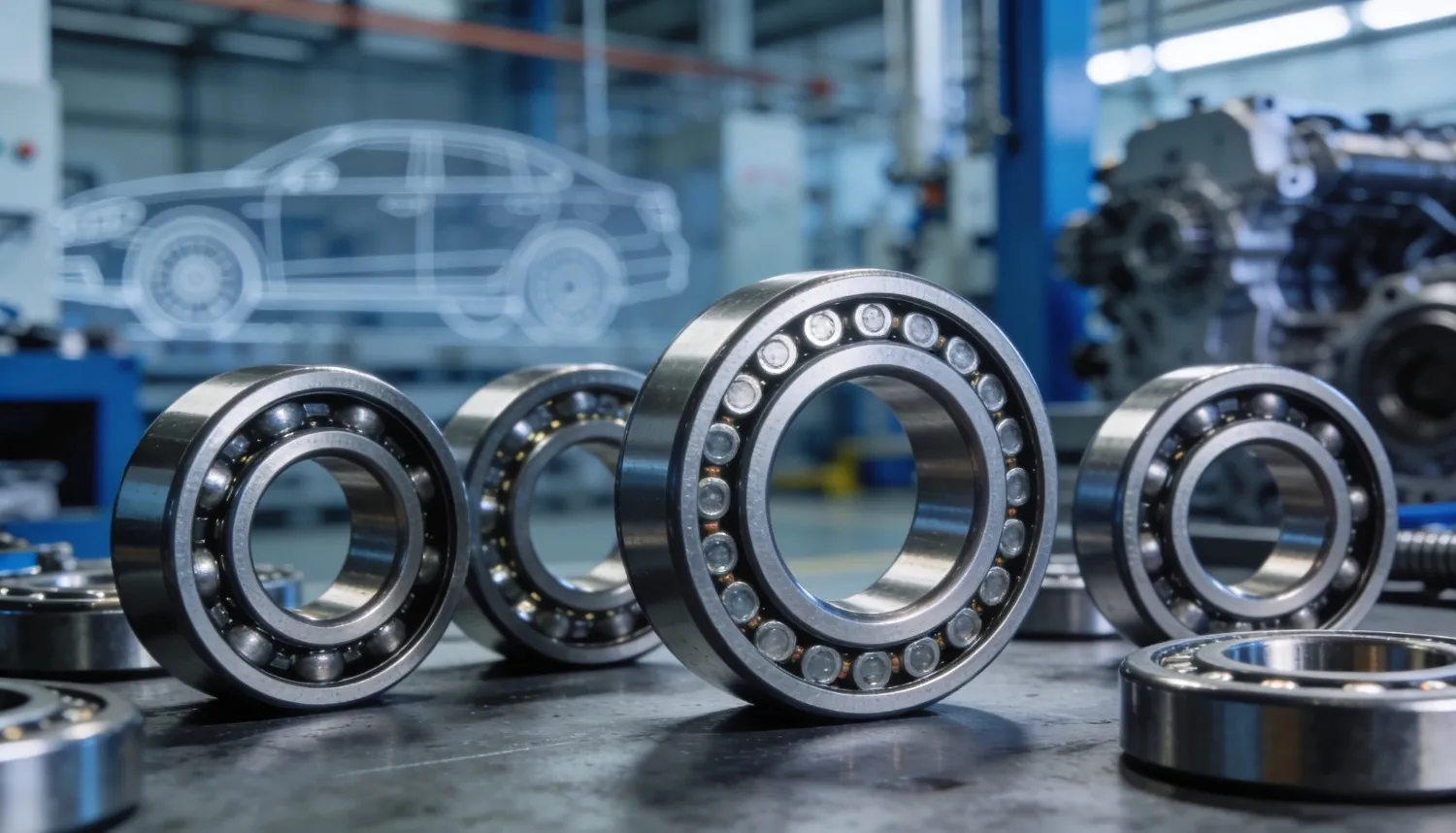
When looking for a component for rotating machinery, it seems clear-cut until you are in the middle of a large catalog with hundreds of options. If you get the Bearing Size wrong, you could create a piece of machinery that will run perfectly for several years or run for only weeks before it fails. If you're an engineer specifying parts for a new build or if you're a maintenance technician replacing a worn component, having a firm understanding of how to match bearings to their job is among the most important practical skills you can develop.
Why Getting the Size Right Matters
Bearings are high-precision elements; an incorrect bearing size, even one millimeter off, can create excessive heat, vibration, premature demise, or catastrophic failure. The Size of a Bearing isn't just about the fitment between a bearing and an object; it's the combination of load capacity, speed rating, operating temperature, and fitting into surrounding structures. Incorrectly sized bearings are overloaded. Oversized bearings cause fitting issues, weigh unnecessarily too much, and cost more than needed—all of which are unacceptable for critical industrial applications.
Step 1: Know Your Load Conditions
Before you even think about dimensions, understand what the bearing will experience in service. There are five key load conditions to consider:
- Radial loads: force acting sideways on the shaft
- Axial loads: force acting along the shaft
- Combined loads: both radial and axial together (most common)
- Shock loads: sudden impact forces
- Speed: high speed needs tighter tolerances
Documenting these conditions at the start filters out unsuitable bearing types immediately and saves significant time later in the selection process.
Step 2: Key Bearing Dimensions
Every bearing is defined by three numbers — bore (d), outside diameter (D), and width (B or T). These decide whether a bearing physically fits your machine.
| Dimension | Purpose |
|---|---|
| Bore (d) | Fits into the shaft |
| Outside Diameter (D) | Fits into the housing |
| Width (B/T/C) | Axial space it occupies |
| Internal Clearance | Controls heat & preload |
| Precision Grade | Controls vibration & accuracy |
Always measure the actual machine—never rely only on drawings.
Step 3: Select the Right Bearing Type
Select the type of bearing that meets your application's requirements after determining your load and size specs by considering different Bearing Types. Each type will have its own strengths that will lend themselves best to certain applications.
For applications requiring moderate radial loads at high speed, the traditional choice is a Ball Bearing since it will provide low friction and accommodate both radial and low axial loads, as well as be offered in a very large number of sizes. Because the rolling element geometry causes contact stress to be distributed over a small area, these types of bearings are very good for precision instruments, electric motors, and lightweight machinery.
If your application involves heavy radial loads, misalignment, or high levels of vibration, a Cylindrical Roller Bearing is a much better option than ball bearings due to the greater radial load capacity these types of bearings provide. The line contact created between the rollers and raceway allows a much more efficient distribution of force than the point-to-point contact provided by ball bearings. You'll find these types of bearings used extensively in gearbox applications, rolling mills, compressors, and other heavy equipment within an industrial setting.
"The bearing type you choose should be driven first by load and speed requirements — not by habit or what was used last time."
Step 4: Consider the Bearing Housing
Just as a bearing does not work alone, neither does a Bearing Housing work alone. The role of the bearing housing in the bearing selection process is just as important. The geometry of the housing will affect alignment and thermal expansion, as well as controlling the fit tolerances that will either result in the bearing outer ring being stationary or rotating as a result of fit tolerance. A loose-fitting outer ring will create fretting corrosion in the bore of the housing; a too-tight-fitting outer ring will make it difficult to remove the outer ring and may compress the outer ring, thus reducing internal clearance.
- A plummer block (or pillow block) housing is the most common selection for horizontal shafts in industrial machinery.
- Flanged housings are used when there is limited space and when the bearing must be mounted to a flat surface.
- Take-up housings are adjustable to allow for change in shaft position—common in conveyor systems. Always verify that the housing bore diameter and housing material are compatible with the bearing series you are selecting.
- stems.
- Split housing designs are easier to maintain in large, heavy-duty installations.
Always check the compatibility between the housing bore diameter and housing material with respect to the bearing series that is being selected.
Related Topic You Might Be Interested In:
Ensuring Smooth Operations Nationwide: How IBH Strengthens India’s Nachi Bearings Supply Chain!
Step 5: How Long Will Your Bearing Last?
Every bearing comes with two numbers in its catalog—a dynamic load rating (C) and a static load rating (C₀). Think of these as the bearing's strength score. The higher these numbers, the more load the bearing can handle.
Next, the bearing capacity needs to be compared against the forces (P) your machine will inflict on it—if the bearing is large and well-suited for the load on it, it will last longer. If the machine is providing high load to the bearing and the bearing is undersized, then the bearing will wear out faster. Engineers use a simple calculation called "L10 life" to estimate this lifespan: how many hours 90 out of 100 identical bearings would run before showing signs of wear.
The simple rule of thumb:
- For most factory machines aim for at least 20,000 to 30,000 hours of bearing life
- For critical equipment (pumps, compressors, continuous production lines) → target 50,000 hours or more
If the calculations fail to meet the expected bearing life, then you will need a larger or stronger bearing, not necessarily a different brand of the same size.
Step 6: Account for Speed, Temperature, and Lubrication
Every bearing has an indicated reference speed and a maximum speed on its data sheet. The benefits of Ball Bearings are lowered friction rates and lower heat creation at higher speeds. In terms of load capacity, however, roller bearings are the most applicable bearing type for slower and heavy-load applications. Usually, paper and plastic bearings can support much higher temperatures than standard bearings, up to 120°C.
Step 7: Work With Qualified Bearing Suppliers
While an understanding of selection requirements is important, Bearing Suppliers who have functional knowledge and experience will save you time and help reduce risk. Compentent distributors can cross-reference your application information to provide you with alternate items that will also work and help you identify items that may not work correctly prior to installing any items.
When evaluating Ball Bearing Manufacturers, consider their dimensional accuracy, material traceability, quality certifications, and technical support capabilities.
Using reputable Ball Bearing Suppliers provides you with dependable availability of legitimate products along with access to the full range of special variants, such as stabilized grades, ceramic hybrids, and custom precision classes for when standard catalog product descriptions are insufficient.
Quick Reference: Bearing Type Selection Guide
| Application Condition | Recommended Type | Key Advantage |
|---|---|---|
| High speed, moderate load | Deep groove ball bearing | Low friction, versatile |
| Heavy radial load, medium speed | Cylindrical roller bearing | High radial capacity |
| Combined radial + axial load | Angular contact ball bearing | Handles both load types |
| Shaft misalignment present | Spherical roller bearing | Self-aligning capability |
| Pure axial (thrust) load | Thrust ball bearing | Efficient axial force transfer |
| Very heavy radial + shock loads | Cylindrical roller bearing (NU/NJ) | Line contact, high capacity |
Mistakes to Avoid
- Relying only on the old bearing’s part number without re-verifying that it was the correct specification to begin with.
- Ignoring internal clearance — standard C3 is not always appropriate; always check if the application justifies a different class.
- Assuming all brands with the same designation are equivalent—quality and precision grades vary significantly between manufacturers.
- Overlooking housing fits—a perfect bearing installed in a worn housing bore will fail early regardless of its quality.
- Skipping lubrication specifications—the wrong grease type or quantity is one of the leading causes of preventable bearing failure.
About US
IBH is committed to making your bearing sourcing effortless and accurate. The perfect fit for you if you are looking for Nachi pillow blocks, Nachi balls, Nachi cylindrical roller bearings, and some other related products. You can find the full catalog and technical resources at IBH. Nachi, a renowned Japanese brand that established its presence in the country almost 8 decades before. The company carry this legacy forward by providing every client technical support and genuine parts they need to keep their operations running smoothly.
The team of professionals understands the specific challenges of the Indian industrial landscape, from thermal expansion issues in the North to salt-air corrosion in coastal regions. Apart from this, IBH also deals with Nachi thrust ball bearings, Nachi balls, Nachi cylindrical roller bearings, and some other related products. The company take pride in being more than just a vendor. Being a trusted partner in your mechanical success.
Frequently Asked Questions (FAQs)
1. How can I find the bearing size if the part number is missing?
Ans: If the identification number has worn off, you can determine the size by taking three precise measurements using a vernier caliper: the Bore (inner diameter), the Outside Diameter (OD), and the width (thickness). Once you have these dimensions in millimeters, you can consult a manufacturer’s catalog to find the matching part.
2. What is the difference between radial and thrust ball bearings?
Ans: The primary difference lies in the direction of the load they are designed to support. Radial bearings are engineered to handle loads that are perpendicular to the shaft (like a rotating wheel), while thrust bearings are specifically designed to support axial loads that act parallel to the shaft.
3. When should I choose cylindrical roller bearings over standard ball versions?
Ans: You should opt for rollers when your application involves heavy radial loads. Because rollers have a larger contact area with the race compared to the "point contact" of balls, they offer much higher load-carrying capacity and greater rigidity under stress.
4. Why is the bearing housing condition important for sizing?
Ans: The housing must provide a precise fit for the outer ring of the bearing. If the housing is worn, corroded, or warped, it can cause the bearing to slip or become misaligned. Even the highest quality bearing will fail prematurely if the housing dimensions do not provide the correct interference or clearance fit.
5. How do I know which bearing types are best for high-speed applications?
Ans: For high-speed requirements, deep groove ball bearings are typically the best choice because they generate less friction and heat. If the application also involves high precision, you might consider angular contact bearings, which are often used in machine tool spindles.
6. Where can I find reliable ball bearing manufacturers for industrial replacement?
Ans: It is best to source from manufacturers with a long-standing global reputation for quality, such as Nachi. Working through authorized bearing suppliers ensures that you receive authentic products that meet strict ISO standards, which is vital for maintaining the safety and efficiency of your machinery.
Conclusion
Choosing the appropriate bearing requires a systematic approach rather than simply guessing. The most suitable way to select an appropriate bearing is to identify precise load types and values, rotational speeds (RPM), and environmental conditions. Then find the most suitable Bearing Dimensions and size for the application. The next steps would be to validate exterior features of the housing, validate the service life of the selected bearing, and work closely with experienced Bearing Suppliers. After the above steps have been completed, a customer can select a bearing with confidence rather than uncertainty.
Get the right bearings with precision, quality, and expert support. Shop Nachi bearings at IBH India Connect Now!