 Trusted industrial bearing supplier delivering durable and high-performance solutions across
industries.
Trusted industrial bearing supplier delivering durable and high-performance solutions across
industries.


Nachi Ball Bearings vs Roller Bearings: Differences & Uses
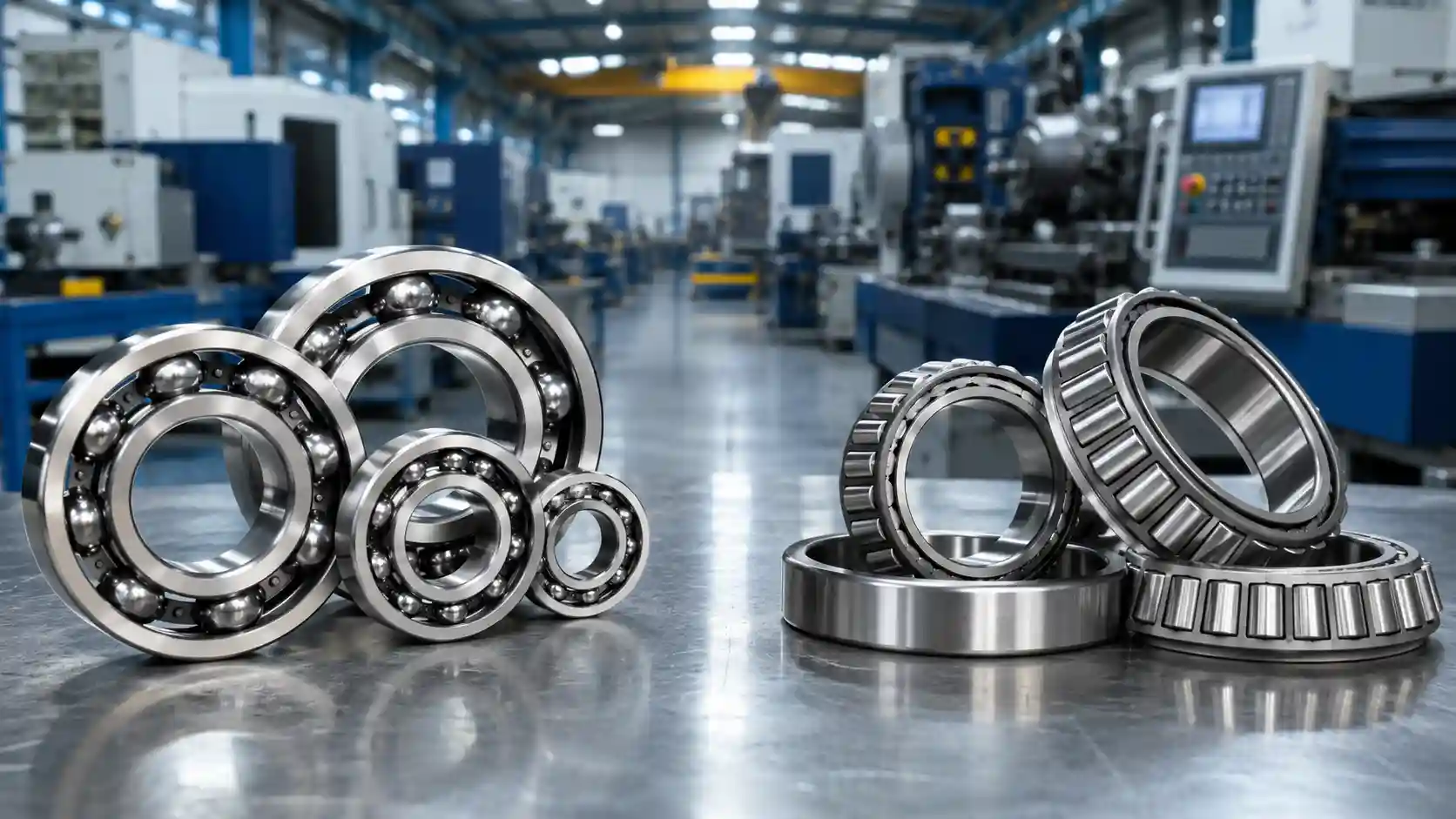
A practical guide to choosing between Nachi Ball Bearings and Nachi Tapered Roller Bearings for industrial use.
Pick the wrong bearing and you pay for it later. Noise, heat, a machine dying way earlier than it should have. Nachi bearings have earned their name by holding up in actual factory conditions, not just on a spec sheet. Two types keep coming up in comparison: Nachi Ball Bearings and Nachi Tapered Roller Bearings. Both spin, both cut friction, but honestly they're not interchangeable. The tapered roller bearings vs ball bearings question basically boils down to this: what's your shaft actually carrying? Radial load only, or axial too? And how fast is it spinning? Get it wrong and you're swapping parts again sooner than budgeted, and nobody enjoys explaining that to a plant manager.
What are Nachi Ball Bearings?
A ball bearing is pretty simple at its core, steel balls sitting between an inner race and an outer race. Since a ball only touches the race at one point, not along a line, friction stays low. That's the whole trick behind why they run so smooth at high RPM. You'll find them doing duty as precision bearings inside spindles, small motors, anywhere accuracy can't slip. They're compact. Quiet too, mostly, once they're broken in and running true. When buying in bulk, going through recognised Nachi Ball Bearings Suppliers in India saves headaches later, since not every seller actually quality-checks stock before shipping it out.
What are Nachi Tapered Roller Bearings?
These work on a different principle. Conical rollers, sitting between angled raceways, so they can take radial and axial force at once instead of just one direction. That angle means more of the roller actually touches the race, which is why load capacity jumps compared to a ball design. You'll see them in gearboxes, wheel hubs, heavy axles, basically anywhere the load isn't simple. Plants running shock-heavy or high-torque equipment usually source through established Nachi Tapered Roller Bearings Suppliers in India, because one bad shipment there can stall a whole line.
Key Features of Both Bearing Types
Quick side by side before we go further, nothing you haven't half-guessed already.
Ball Bearings:
- Point contact, low friction, less heat
- Built more for speed than raw load
- Small, fits where space is tight
- Copes with light axial load bearings duty okay
Tapered Roller Bearings:
- Line contact, spreads load out
- Handles radial and axial together
- Comes in single, double, four-row versions
- Usually the pick for heavy gear systems
Load Capacity Comparison
Here's where they really diverge. Ball bearing load capacity is fine, decent even, but point contact means the load sits on a tiny area. Works great at speed, under light-to-moderate load. Push it past that and wear shows up fast. Tapered rollers spread the same force across a line, not a point, so stress per area drops and they simply take more abuse. Wheel hubs are the classic case, radial and axial hitting together, exactly the scenario these were built for. A ball bearing stuck there won't last as long, even brand new, so it's not really a fair fight in that spot.
TRIVIA: "Bearing" traces back to the old verb "to bear," as in to carry weight, which is quite literally what it does all day.
Applications of Nachi Ball Bearings
Where do these actually turn up?
- Electric motors, home appliances
- Precision machine tools, spindles
- Fans, blowers, pumps
- Small automotive gearboxes, accessories
- Agricultural equipment parts
Anywhere smooth rotation matters more than brute strength, industrial ball bearings are usually the answer, and they tend to just keep running.
Applications of Nachi Tapered Roller Bearings
Now the tougher jobs.
- Wheel hubs, differentials
- Industrial gearboxes, speed reducers
- Mining, construction machinery
- Rolling mills, large conveyors
- Pump and motor shaft support
Wherever the load keeps shifting direction, or the machine never really stops, industrial roller bearings hold up better in the long run.
Comparison Table: Nachi Ball Bearings vs. Nachi Tapered Roller Bearings
Understand the comparison in-depth with the following table:
| Aspect | Nachi Ball Bearings | Nachi Tapered Roller Bearings |
|---|---|---|
| Contact Type | Point contact | Line contact |
| Load Handling | Primarily radial, light axial | Combined radial and axial |
| Speed Suitability | High-speed operation | Moderate to high speed |
| Typical Use | Precision, light-duty equipment | Heavy-duty, high-load equipment |
| Maintenance | Generally lower maintenance | Requires periodic clearance adjustment |
Advantages and Limitations of Both
No bearing wins at everything. Here's the honest split.
Ball Bearings, good:
- Low friction, less heat
- Quick to install, easy upkeep
- Runs well at high speed
Ball Bearings, not great:
- Axial load capacity falls short of tapered designs
- Doesn't like shock loading much
Tapered Rollers, good:
- Solid in radial and axial directions both
- Shrugs off shock loads
- Made for constant, heavy duty
Tapered Rollers, not great:
- A bit more friction, comes with line contact
- Clearance setup during install takes real care, not a rush job
DID YOU KNOW: Railways were actually first to use tapered roller bearings, back when standard ball bearings couldn't handle the combined loads on an axle.
How to Choose the Right Nachi Bearing
Worth asking yourself these before placing an order.
- Is the load radial, axial, or a mix of both?
- What speed is this actually running at, day to day?
- How much room do you have to mount it?
- Once it's in, can someone actually service it easily?
- What's the environment, dusty, wet, hot?
- Still unsure? A supplier who deals in both industrial ball bearings and industrial roller bearings regularly has probably seen your exact case before
FACT: Bearing failure sits behind a surprising chunk of unplanned factory downtime, more than most people would guess.
Expert Tips for Bearing Selection
A few things that matter more than people expect.
- Match tolerance class to what the equipment needs, nothing fancier
- Don't mix bearing types on one shaft without an engineer signing off
- Keep bearings dry and clean before fitting, dirt kills them fast
- Replace in pairs on matched setups so the load stays even
- Time inspections by running hours, not by the calendar
Do this consistently and bearings just last longer, plain and simple, nothing complicated about it.
About IBH
IBH, your reliable Nachi Bearing Distributor, Dealer & Supplier in India. IBH is associated with Nachi, a renowned Japanese brand, established its presence in the country almost 8 decades before. IBH established in 1973 the company has more than 80 years experience to ease the sourcing and bearing needs. With the availability of Nachi Technology India Pvt. Ltd. (NTID), who manufactures bearing solutions from their technologically sound plant in Neemrana, Rajasthan IBH is a dependable solution provider that deals with all Nachi pillow blocks, thrust ball bearings, cylindrical roller bearings, etc., equipped with a complete catalogue and all the technical backup available in the industry.
FAQs
1. What happens if I install a bearing with the wrong clearance?
Ans: Too tight, it overheats fast, sometimes seizes within hours. Too loose, you're stuck with vibration, noise, uneven wear, the whole mess. Tapered rollers are fussy about this during setup, no shortcuts really work here. Get the clearance dialed in properly up front, saves a headache down the line.
2. Ball bearings or tapered rollers, which one actually lasts longer?
Ans: Honestly depends on the job. Light, high-speed loads, ball bearings often outlast tapered ones, less friction wearing them down over time. Throw heavy or shock loads in though, and tapered rollers pull ahead fast. No clear winner overall, comes down to matching the bearing to what it's dealing with daily.
3. Do Nachi Tapered Roller Bearings need more maintenance than ball bearings?
Ans: A bit, yeah. Clearance adjustment during install takes real care, not something you rush. Ball bearings are more forgiving, easier to fit, mostly self-sufficient once running. That said, tapered rollers pay you back for the extra setup time, holding up under heavy, nonstop industrial loads.
4. Do only big factories use Nachi bearings, or is that overkill for smaller setups?
Ans: Not overkill at all. Small motors, fans, pumps, even household appliances run on Nachi Ball Bearings regularly. Smaller operations running agricultural gear or basic machinery still depend on solid components. Size of the business doesn't really change this, a failed bearing still means downtime and cost either way.
5. How do I know if my machine needs axial load support or just radial?
Ans: Watch how force actually hits the shaft. Purely rotational, that's radial. Something pushing sideways too, say a gear or wheel hub setup, that's axial. Mixed loads usually point toward tapered rollers. Still not sure? Get an experienced supplier to look at your setup and confirm it directly.
6. When a supplier calls a bearing "quality-tested," what does that actually cover?
Ans: Usually means dimensional accuracy, surface finish, load tolerance, checked before anything ships. Suppliers worth trusting don't cut corners on this, even when they're rushing to clear stock. That gap is basically why one bearing runs true for years and another one dies within weeks. Worth asking them how they test.
Conclusion
So, which one fits your setup? Fast-running machine, light-to-moderate load, ball bearings usually make sense, less friction, simpler upkeep. Heavy load, combined forces, shock hits, tapered rollers hold up better over time. There's no single winner here, it depends entirely on what the equipment is actually doing. Looking for Nachi Ball Bearings Dealers in India or Nachi Tapered Roller Bearings Dealers in India, either way, stick with someone who actually checks stock before it goes out the door. Genuine parts work out cheaper than cheap parts that fail early, every time.
| Need a hand picking the right Nachi bearing for your setup? Reach out to our team at IBH to get the best product. |