 Trusted industrial bearing supplier delivering durable and high-performance solutions across
industries.
Trusted industrial bearing supplier delivering durable and high-performance solutions across
industries.


A Complete Guide to Choosing Ball Bearings for Heavy-Duty Applications
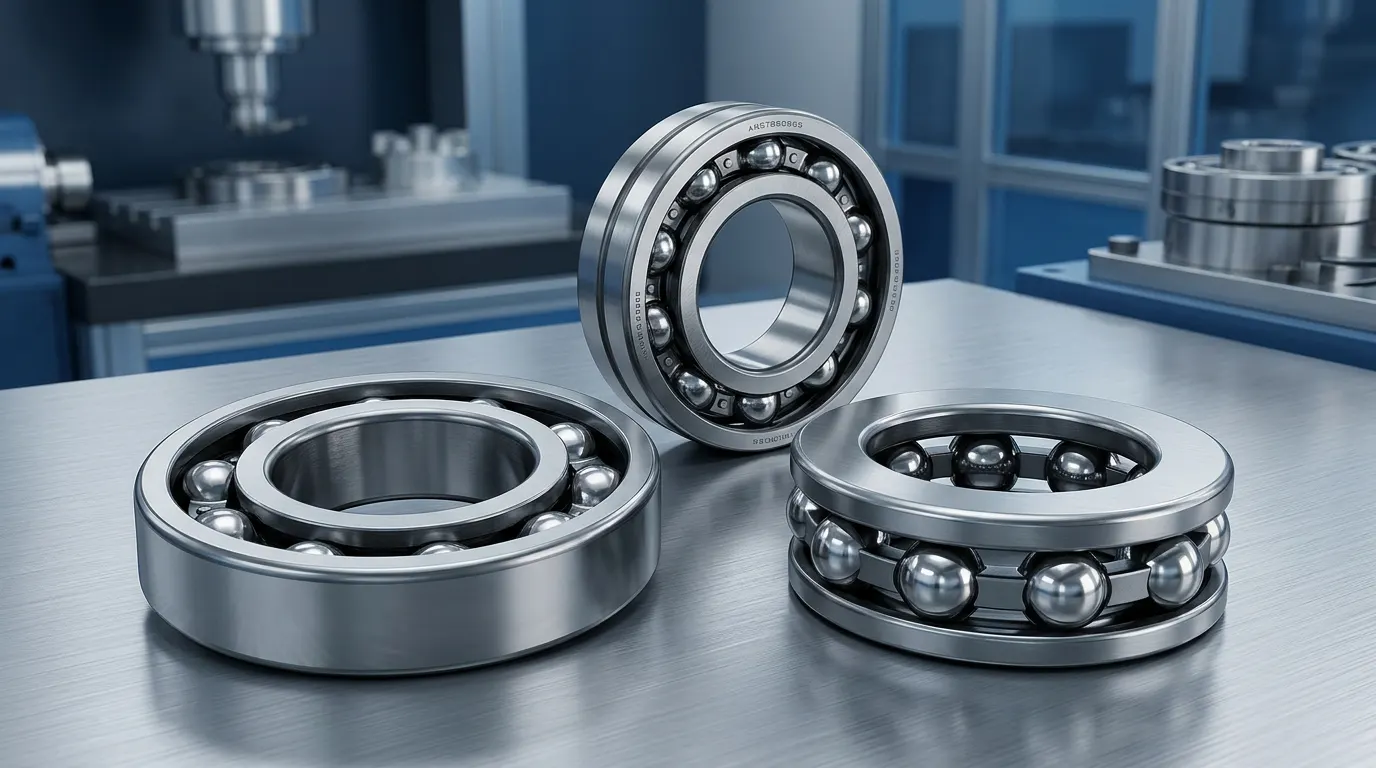
Most procurement teams notice Ball Bearings only after something fails. A motor trips at midnight. A conveyor dies mid-shift. Someone pulls the bearing out and realises — wrong type, wrong fit, maybe even fake. That one decision cost the plant hours of production.
Heavy-duty machines don’t forgive bad bearing choices. This guide cuts through the confusion so you pick the right Industrial Ball Bearings the first time — not after a breakdown teaches you the lesson.
What is a Ball Bearing?
A Ball Bearing is a rolling-element device with four parts: inner ring, outer ring, steel balls, and a cage. The balls roll between the rings. Rolling contact replaces sliding contact — that switch alone cuts friction to a fraction of what plain bushings produce.
Some Bearing Ball Bearing units come sealed — rubber or metal shields lock grease in, keep contamination out. Others stay open for re-lubrication. Which setup you need depends on your operating environment. Not personal preference. Not cost. Environment and application — full stop.
Why Are Ball Bearings Important in Industrial Machines?
Heavy Duty Ball Bearings hold shafts in position while carrying load — radial force pushing across the shaft, axial force pushing along it. They do this continuously. Sometimes at 3,000 RPM. Sometimes under several tons of pressure. Often both at once.
What they’re actually doing inside the machine:
- Absorbing radial load — weight or force acting across the shaft
- Taking axial thrust — forces pushing along the shaft length
- Keeping shafts aligned — tolerances stay tight even under speed
- Controlling heat — rolling friction generates far less heat than sliding contact
The balls and bearings assembly is what separates productive equipment from equipment that constantly needs attention.
|
TRIVIA Leonardo da Vinci sketched rolling-element bearing concepts in the 1490s. The physics haven’t changed. Only the steel quality and tolerances have. |
Ball Bearing Types for Heavy-Duty Use
IBH India stocks five Nachi Ball Bearing Types that cover most heavy-duty scenarios. Each handles a different load situation — picking wrong is expensive:
Deep Groove Ball Bearings
The most common type on any shop floor. Handles radial and axial loads in both directions. Low maintenance, wide speed range, available open, shielded, or sealed. Motors, pumps, gearboxes, agri machinery — if you’re unsure where to start, start here.
Angular Contact Ball Bearings
Built for combined radial and axial loads from one direction. Stiffer than deep groove. CNC spindles, compressors, robotics — anywhere shaft play can’t be tolerated, this is the type.
Self-Aligning Ball Bearings
Two rows of balls, one curved outer raceway. Tolerates shaft deflection without protesting. Conveyors, paper mills, agricultural drives — setups where perfect shaft alignment is genuinely difficult to maintain.
Thrust Ball Bearings
Pure axial load only. Nothing radial. Compact for what they handle. Automotive clutches, crane hooks, vertical shafts — jobs where force runs along the axis, not across it.
Miniature and Precision Bearings
Small form factor, tight tolerances. Medical devices, dental instruments, aerospace components — space-constrained jobs where accuracy outweighs load capacity.
Quick reference — Bearing Types at a Glance:
| Bearing Type | Load Handled | Common Use |
|---|---|---|
| Deep Groove | Radial + axial both sides | Motors, pumps, gearboxes |
| Angular Contact | Combined, one axial direction | CNC spindles, compressors |
| Self-Aligning | Radial with shaft flex | Conveyors, agri equipment |
| Thrust Ball | Pure axial only | Clutches, vertical shafts |
| Miniature & Precision | Light loads, tight spaces | Medical, aerospace, instruments |
|
DID YOU KNOW? Chrome steel (AISI 52100) is the standard for Industrial Ball Bearings — hard, fatigue-resistant, dimensionally stable under heat. That’s why it’s still the default after decades. |
Key Features to Look For When Buying
Specs matter. When comparing Bearing Ball options, these are the numbers and details that actually decide field performance:
- Dynamic load rating (C) — load the bearing handles at rated speed before fatigue sets in
- Static load rating (C0) — for slow or stationary load applications; higher means more margin
- Speed rating — hard ceiling; run above it and heat builds fast
- Sealing type — sealed for dirty or wet environments; open where re-lubrication is routine
- Clearance class — C3 suits most heavy-duty industrial use; tighter for precision equipment
- Cage material — steel for heavy load, polyamide for quieter high-speed running
Benefits of Using Quality Industrial Ball Bearings
The math is simple. Right Industrial Ball Bearings from a trusted source mean:
- Lower energy bills — less friction, less load on the motor driving the shaft
- Longer machine life — bearings that fit the application don’t stress adjacent components
- Fewer emergency shutdowns — properly rated bearings don’t fail mid-production
- Tighter output quality — stable rotation keeps machine tolerances consistent
- Reduced maintenance frequency — correct spec means longer service intervals
IBH India supplies Nachi Heavy Duty Ball Bearings across sectors where machine reliability isn’t optional. Ball Bearing Applications span:
- Automotive — wheel hubs, alternators, gearboxes, steering columns
- Pumps and motors — electric motor shafts, centrifugal and submersible pumps
- Agriculture — harvesters, threshers, irrigation pump drives
- Sugar and paper — heavy rollers and conveyor shafts running continuous shifts
- Home appliances — washing machines, fans, air conditioner compressors
|
FACT Bearing failure causes close to 40% of industrial motor breakdowns. Most trace back to wrong selection or neglected lubrication — not a defective bearing. |
Ball Bearing Maintenance: Tips That Actually Work
Even a quality Ball Bearing fails early without consistent care. Ball Bearing Maintenance isn’t complicated — it just has to happen:
- Lubricate at the right interval — over-greasing causes overheating just as under-greasing does
- Track temperature — unexpected heat rise is a warning, not normal break-in
- Listen for vibration shifts — irregular noise means check it this shift, not next week
- Install on the correct ring — force on inner ring for shaft fit, outer for housing; never both simultaneously
- Store properly — original packaging, dry clean space, no vibration source nearby
Expert Tips: How to Choose the Right Ball Bearings Suppliers
Specification gets you halfway. The other half is sourcing from the right Ball Bearings Suppliers. Wrong supplier undoes good spec decisions:
- Verify authenticity — counterfeits pass visual checks easily; only buy from authorised distributors
- Check stock depth — a supplier always out of your part costs more in downtime than the bearing itself
- Expect technical input — a proper supplier asks about your application before quoting part numbers
- Confirm restocking reliability — industrial operations can’t depend on order-by-order uncertainty
IBH
IBH, your reliable Nachi Bearing Distributor, Dealer & Supplier in India. IBH is associated with Nachi, a renowned Japanese brand, established its presence in the country almost 8 decades before. IBH established in 1973 the company has more than 80 years experience to ease the sourcing and bearing needs. With the availability of Nachi Technology India Pvt. Ltd. (NTID), who manufactures bearing solutions from their technologically sound plant in Neemrana, Rajasthan IBH is a dependable solution provider that deals with all Nachi pillow blocks, thrust ball bearings, cylindrical roller bearings, etc., equipped with a complete catalogue and all the technical backup available in the industry.
FAQs
1. What is the purpose of using ball bearings in machines?
Ans: Ball bearings reduce friction between rotating parts. They carry radial and axial loads while keeping shafts stable. Without them, metal-on-metal contact destroys equipment fast and energy consumption shoots up unnecessarily.
2. What is a ball bearing?
Ans: A ball bearing has four parts — inner ring, outer ring, steel balls, and a cage. Balls roll between the rings instead of sliding, which cuts friction dramatically and lets shafts spin freely under heavy continuous load.
3. What are the main ball bearing types used in industry?
Ans: Deep groove, angular contact, self-aligning, thrust, and miniature precision bearings are the main types. Each handles different load directions. Picking the wrong type for your application causes premature failure and unexpected downtime.
4. How do I know when a ball bearing needs replacement?
Ans: Unusual noise, heat buildup, shaft vibration, or visible grease leakage are clear signs. Don't wait for complete failure. Catching a worn bearing early saves the shaft, housing, and surrounding components from damage.
5. What is the importance of ball bearing maintenance?
Ans: Correct lubrication intervals, proper installation, and temperature monitoring keep bearings running longer. Over-greasing is as damaging as under-greasing. Most premature bearing failures aren't defects — they're maintenance mistakes that compound over time.
6. How do I choose the right ball bearings supplier in India?
Ans: Always buy from authorised distributors only. Counterfeits look identical but fail under load within weeks. Check stock availability, technical support quality, and supply consistency before finalising any industrial ball bearings supplier.
Conclusion
Ball Bearings are small parts with outsized consequences. A mismatched Bearing Ball doesn’t just fail on its own — it loads adjacent components unevenly, accelerates wear across the assembly, and stops production without warning.
IBH Bearings Pvt. Ltd. is an authorised Nachi distributor supplying deep groove, angular contact, thrust, self-aligning, and miniature Industrial Ball Bearings — with technical support and dependable stock across industries.
Have a specific application? Talk to IBH Bearings and get the right bearing specified — not just the nearest available part.